
Introduction: Causes of Child Labour
The causes of child labour is a serious and complicated challenge for millions of children across the globe. It deprives them of a safe environment, a healthy childhood, education, and their full and appropriate development as children. This article examines the leading causes of child labour in an effort to enable the reader to see why children are forced into work and what can be done to eliminate it.
Poverty: The Leading Causes of Child Labour
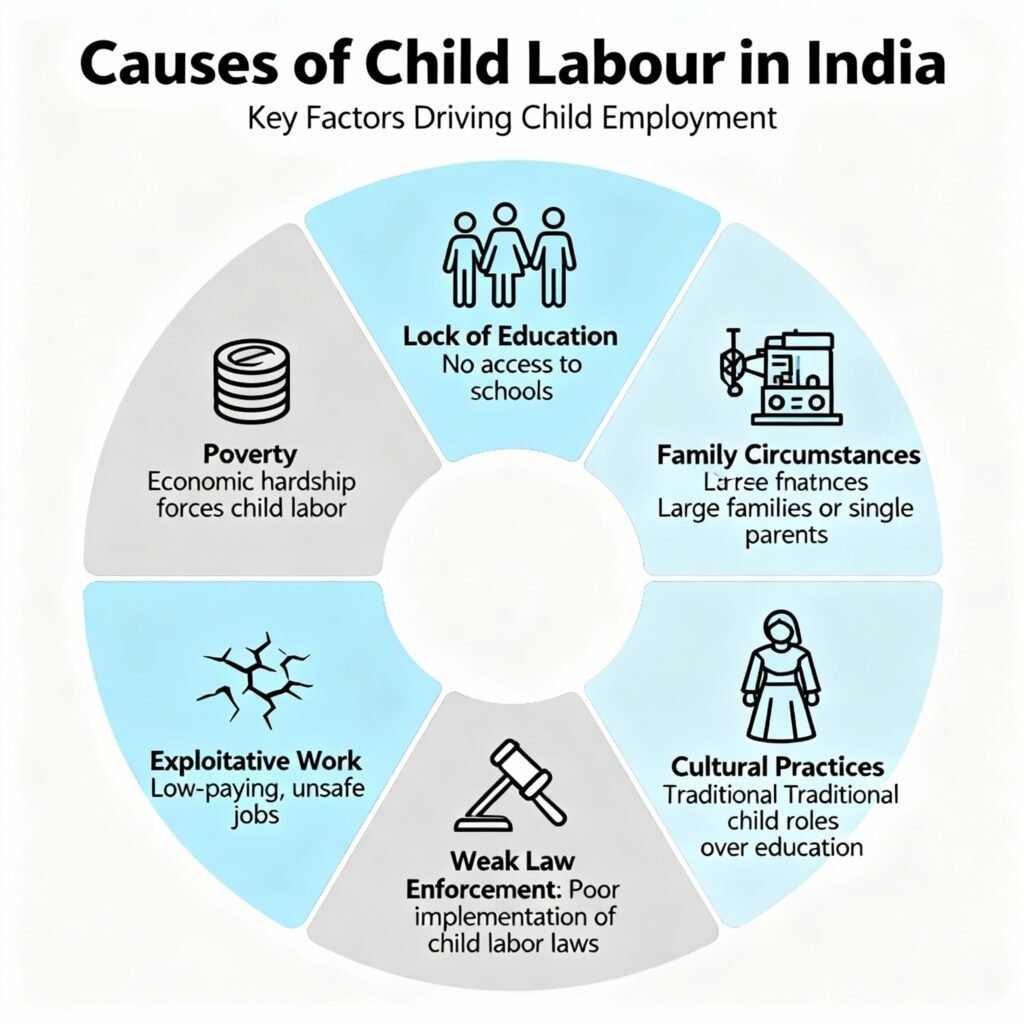
Poverty is one of the major causes of child labour in India. Due to poverty, many families are unable to meet basic needs such as food, shelter, and medicine. As a result, they send children to work on farms or in factories in homes to help support the family income, which feeds the cycle of child labour in India. Children lose the chance to go to school and learn the skills that create a better quality of life, social mobility, or movement up the economic ladder as a result of this behavior, or, at a minimum, have skills that add to the economy. Solutions that address poverty include child labour programs that are effective, government assistance, social safety nets, and parent assistance through acting upon support systems, while also, of course, supporting education for children.
Lack of Access to Education
Another big reason kids work is that it’s challenging to attend to school, it’s too expensive, or it’s not very satisfactory. This means that kids have to work to support themselves and their families instead of going to school and getting a better future. Child labor in India is still a problem, even though there are laws like the Right to Education Act. This is because kids don’t go to school, the schools are inadequate, and the teachers are poor. To stop child labour in India and help kids break the cycle of work and poverty, it is important to ensure that school is available, affordable, and fun.
Family Circumstances and Social Pressure
Family situations can make it much more likely that kids will have to work. When parents are unemployed, live alone, or have many kids, they often make their kids work or help with chores around the house. In some places, it’s normal for kids to work early because their peers or the community expect them to help out financially. These are some of the main reasons why children work in India. To stop child labour in India, we need to teach people about its long-term effects and ensure that all children have access to adequate educational opportunities.
Exploitative Work Environments
In abusive and exploitative workplaces, children are subjected to unhealthy and dangerous working conditions, experiencing a lack of education and safety. Child workers frequently work excessive hours for little or no wages while dealing with dangerous machinery, toxic chemicals or heavy lifting. Many children will experience physical and emotional abuse, particularly in industries such as agriculture, domestic work, mining and manufacturing. The exploitative labor can have a number of negative consequences on child workers’ physical health, emotional well-being, and future opportunities – keeping them caught in a cycle of poverty and vulnerability.
Natural Disasters and Crises
Natural disasters and other crises can disrupt families’ lives in painful ways. Floods, storms, and conflicts can destroy homes and livelihoods. Families often struggle to survive, and many children leave school and work to help their families. In these cases, kids may have to take dangerous jobs to support their families, ruining their childhoods and dreams. Providing support to vulnerable families in crisis can help prevent children from being forced into child labour or work.
Weak Enforcement of Child Labour Laws
The issue of poor enforcement of India’s child labour laws remains a challenge, but genuine progress is being made each day. Due to the commitment of labour inspectors and the tireless work of NGOs, thousands of child labourers have been rescued from exploitative workplaces and provided an opportunity to return to school. Increased training for inspectors, greater community engagement, and improved compliance with the law are making a real impact. These initiatives offered some measure of hope for children and protected their rights, and it means that we, as a community, actually took steps toward ending child labour. Currently, our observations on the ground confirm that prioritizing enforcement results in significant life-altering impacts.
Cultural and Traditional Practices
In other areas, cultural and customary norms define causes of child labour, where children are anticipated to work for the family business, domestic chores, or society at an early age. Although these activities are innocuous, they have impacts on education and development in general. Changing To solve the problem of child labor, we need to raise awareness and engage people involved in the community to encourage parents to put education ahead of work. This will slowly change how people think and provide kids a chance to do well.
Conclusion:
Causes of Child labour require collective action by governments, businesses, communities, and individuals. Children can only be protected if individual actors come together for progress by sharing expertise and resources. Logic dictates that if program and policy actors worldwide agree that family support, enhanced educational access, regulatory enforcement, and sustainable design are vehicles to working together to guard children’s rights, then the cycle of child labour can, as a community, shift to child development. More importantly, children’s freedoms will be established, thus granting children the opportunity to grow, learn, and prosper in a positive and protective environment. Making meaningful change to stop child labor is only accomplished by collaboration and collective action.
Read More: https://julieure.com/building-strong-futures-with-girls-education-in-india/